日志
The urgent situation in Britain healthcare
|
The urgent situation in Britain healthcare
Frank Li, March 2, 2026
Feb 27 2026 , I rote article UK PM Keir Starmer returned path of David; in which I indicate that in Britain, the rational politician Sir Vince Cable is able to reform the governance of Britain by learning the Technocratic Democracy of China by outstanding elites part time self reliance working as lawmaker, but in Britain for unrest concern, it must keep current politicla body as normal as it is; then based on which form a civil legislature taking 30% of vote right to parallel run with Gov-one to fix the flaw of the magic political design legally set opposition to dysfunction of legislature.
a British politician who once worked as Leader of the Liberal Democrats, Member of Parliament; the Cabinet as Secretary of State for Business, Innovation and Skills and President of the Board of Trade.
Cameron
This Googled articles that warn the urgent stuation in Britain healthcre system.
Jan 25, 2026, It is the trusted scholars in purposely kill people
Feb 3, 2026, How long is the the waiting list for hospital treatment?
https://researchbriefings.files.parliament.uk/documents/CBP-7281/CBP-7281.pdf
Jan 26 2026, The hospitals where waiting times are getting worse. Is yours one of them?
https://www.bbc.com/news/articles/ckgjk89n2nyo
Britain Industrial Revolution gave birth to both capitalism and communism. As a founder capitalist leader, Britain actually nationalized to establish the communist style welfare system from cradle to grave; with a communist universal healthcare system, Canada followed suit. Now, due to no treatment available, both have people died from the long wait.
When Britain and Canada communist run their healthcare; in many countries, the healthcares are legally greedy used; and health insurance companies colluding with hospitals plunder make increasingly families bankrupt from illness.
For greedy; sacred academic community actually provides false reports to support the drug maker plunder.
It is difficult to change the situation; only way out is to help people reducing the reliant on public healthcare.
Luckily; while nature creates diseases for humans, it also prepared way to deal with. TCM philosophy is able to help us find and properly utilize them. The long use proved that  https://researchbriefings.files.parliament.uk/documents/CBP-7281/CBP-7281.pdf
NHS Key Statistics: England (CBP 07281) (697 KB , PDF)
Before 2020, the NHS in England experienced increasing demand and declining performance on its main waiting time measures.
Many of these pressures have increased following the covid-19 pandemic.
How long is the the waiting list for hospital treatment?

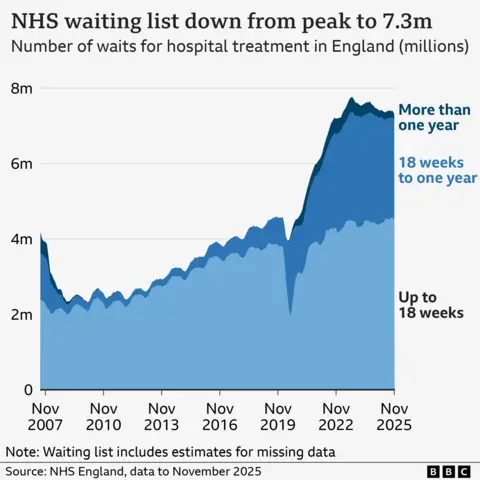
The waiting list for hospital treatment rose to a record of 7.7 million in September 2023, but has since fallen to around 7.3 million in November 2025. The 18-week treatment target has not been met since 2016.
Source: NHS England, Consultant-Led Referral to Treatment Waiting Times
How long are waiting times in A&E?

The proportion of patients spending more than 4 hours in hospital A&E grew substantially between 2015 and 2020. A new record high of 50.4% was reached in December 2022. In December 2025, 40.4% of patients waited over 4 hours in hospital A&E.
The number of patients waiting over 12 hours for admission after a decision to admit has increased substantially since the middle of 2021.

Source: NHS England, Accident and Emergency Attendances and Emergency Admissions
How long are waiting times for cancer treatment?

The 62-day waiting time standard for cancer has not been met in recent years. Targets have recently changed – see section 3 of the full PDF briefing for details. Previously, the standard measured only waits after GP referral, but now other routes are included, covering around 43% more patients. The 85% target remains the same. In November 2025, on the new standard, 70.2% of patients were treated within 62 days of referral.
Source: NHS England, Cancer Waiting Times
How have NHS staff numbers changed over time?

NHS staff numbers have increased, with doctor numbers up 24% and nurses up 25% over the five years to June 2025. The NHS vacancy rate was 6.7% in September 2025, down from 7.4% in September 2024.
These workforce figures do not adjust for changes in demand or activity.
Source: NHS Digital, NHS Workforce Statistics
How long are waiting times for ambulances?

Ambulance response times have risen, with the average response to a Category 2 call (for e.g. suspected heart attacks and strokes) at over 1 hour 30 minutes in December 2022 compared with a target of 18 minutes. Performance has subsequently improved but remains outside the target.
Source: NHS England, Ambulance Quality Indicators
The full PDF briefing paper examines trends in the following areas:
- Accident & Emergency attendance and performance
- Ambulance demand and response times
- Waiting times and waiting lists for routine treatment
- Waiting times for cancer diagnosis and treatment
- Diagnostic waiting times and activity
- GP appointments
- Workforce numbers for doctors, nurses and other staff
- Bed availability and occupancy
For information on NHS funding and mental health services, please see our separate briefings:
Health is a devolved policy area and these statistics relate to the NHS in England only. Links to statistics for Scotland, Wales and Northern Ireland can be found below.
Jan 26 2026, The hospitals where waiting times are getting worse. Is yours one of them?
https://www.bbc.com/news/articles/ckgjk89n2nyo
By Nick Triggle, Health correspondentand
Hitting the 18-week waiting target for treatments such as knee and hip operations was Labour's key manifesto pledge for the health service, and last January it set out how it would get hospitals on track.
While nationally progress is being made, 31 hospital trusts have gone backwards and another 17 have made little progress out of the 129 services examined.
The hospitals struggling the most said they were facing a variety of challenges, including staffing shortages, doctor strikes and problems with IT systems.
'Living in pain'
Mary Waterhouse, 72, from Blackpool, is one of many patients who has faced delays at a hospital where waits are getting worse.
She has arthritis and has been receiving treatment from Blackpool Hospitals NHS Trust since 2022. She was initially given steroid injections, but was referred back on to the waiting list in late 2024 as her condition worsened.
She had to wait eight months to get assessed, but by that point her health had deteriorated so much she was told she would need hip and knee replacements on both sides.
 Mary Waterhouse had to wait eight months for an assessment after her arthritis deteriorated
She opted against treatment. "My arthritis was too advanced – and it was too many operations. I have decided to live with the pain. I had long waits at every stage since first being referred. It's like being in a never-ending queue.
"I now rely on a mobility scooter to get about – I can only walk short distances with crutches. If I had received quicker treatment, things may have been better."
Deborah Alsina, of Arthritis UK, said Mary's case was typical of the problems being faced by many thousands of people with arthritis.
She said timely treatment can be "life-changing", but there was not equitable access to care.
Blackpool said it could not comment on Mary's case, but chief executive Maggie Oldham acknowledged waits were too long.
"We know we're not where we need to be, but we're continuing to work hard alongside our partners to address the issues we're facing urgently."
The government has made improving waiting times its key priority for the NHS and has pledged to get back to hitting the 18-week waiting time target in England by March 2029. It has not been met since 2015.
The target requires 92% of patients to be seen in 18 weeks. An interim national target of 65% has been set for March 2026.
When the government published its plan last January, 59.2% of patients were waiting less than 18 weeks; that has now improved to 61.8%. The size of the waiting list has also fallen to 7.31 million – the lowest level since February 2023.
But locally there are big differences in performance, despite dedicated funding having been set aside to help NHS trusts - which have been given their own individual targets for improvement.
The BBC was able to compare current performance with the position 12 months ago at all but two hospital trusts – data was not available for Sheffield and Barking, Havering and Redbridge hospital trusts.
While published in January, the data lags by a couple of months so marks the position at the end of November in both 2024 and 2025.
East Cheshire has had the biggest drop, going from 61.2% of patients waiting less than 18 weeks to 51.2%.
Barnsley saw a drop of nine percentage points, while both Whittington Health and Epsom and St Helier NHS trusts experienced falls of around five percentage points.
NHS trusts said a variety of factors were at play. Epsom and St Helier cited the introduction of a new electronic patient record system which disrupted services, while Barnsley said staff shortages and an increase in cancer referrals which had to be prioritised ahead of planned treatments had caused problems.
Strike action by resident doctors was also blamed – the number of doctors walking out during industrial action has varied from place to place.
Barnsley and Epsom and St Helier both said they expected performance to start improving.
Of the 98 that had seen progress in the past year, 17 had only improved by less than one percentage point.
But some had seen big jumps. Five NHS trusts recorded improvements of between nine and 10 percentage points and Shrewsbury and Telford, which was one of the worst performers a year ago, by 17.
'Stark differences'
The 18-week pledge only applies to England, but targets for hospital treatments are being routinely missed in other parts of the UK.
Rory Deighton, of the NHS Confederation, which represents NHS trusts, said: "The NHS is not one homogenous body but is made up of hundreds of separate organisations, each with their own distinct financial and operational challenges.
"This means that tackling care backlogs will be more difficult in some parts of the country than others – particularly if there are entrenched challenges, such as high levels of local deprivation."
Chris McCann, deputy chief executive at patient watchdog Healthwatch England, said the analysis showed there were "stark differences" for patients depending on where they live.
"Those responsible for monitoring NHS trusts must pay close attention to organisations that are not only performing poorly but actually deteriorating," he added.
A Department of Health and Social Care spokeswoman said the government had got the NHS on the "road to recovery" but there was still more to do.
She said investment was being made in services such as new surgical hubs and evening and weekend scanning, which would help.
And she said individual hospitals would be held to account for their performance.
Get our flagship newsletter with all the headlines you need to start the day. Sign up here.


